Project Overview
The #Astronomy2024 Legacy Project is a nationwide initiative dedicated to expanding the impact of the 2024 International Astronomical Union General Assembly (IAU-GA), the first-ever held in Africa. The project inspires the next generation of scientists by fostering long-term engagement with astronomy and STEM across South African communities.
Project Goals
- Extend the legacy of the IAU-GA by broadening access to astronomy and STEM education.
- Distribute 100 TV systems to selected schools and science centers, empowering learners with digital learning tools.
- Provide hands-on outreach and mentorship through the Legacy Ambassador Initiative, where volunteers lead interactive science activities and inspire young minds.
- Establish sustainable engagement through virtual learning sessions, live-streamed events, and continued partnerships with schools and science centers.
Profile of Ambassadors, Science Centers, and Schools
Ambassadors Profiles
At the heart of the Legacy Project are 23 ambassadors, passionate individuals who connect science to learners in meaningful ways. The ambassadors represented all 11 official South African languages, and hailing from towns and cities across the country, these ambassadors consisted of undergraduate and postgraduate students, working professionals, and others with STEM experience.
They include undergraduate and postgraduate students, professionals, and STEM enthusiasts. Their role goes beyond delivering lessons—Conduct school visits, deliver talks, facilitate hands-on activities, mentor learners, and assist in TV system setup.
Schools and Science Centers
Through partnerships with science centers across South Africa, the project ensures a lasting impact. These centers provide mentorship, hands-on guidance, and job-shadowing opportunities for ambassadors. They work closely with schools to integrate technology, run outreach activities, and maintain ongoing engagement—making sure learning goes far beyond a single visit.
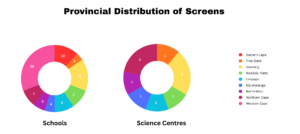
The project currently reaches 84 schools, with a focus on lower-quintile communities in all provinces. Each school receives a 40-inch TV, Raspberry Pi computer, keyboard, mouse, and webcam, transforming classrooms into interactive hubs. Here, students can explore astronomy, conduct experiments, and join live sessions with scientists. From the Western Cape to Mpumalanga, learners across the country can see, touch, and experience science in action.
Participating Science Centers:
| PROVINCE | TOWN | SCIENCE CENTRE/PARTNER | NUMBER OF SCHOOLS/TV SYSTEMS |
| NORTH WEST | Potchefstroom and Mafikeng | North-West University Science Centre | 6 |
| KZN | Sibhayi and Newcastle | Christoph Meyer and Arcelormittal Newcastle | 6 |
| GAUTENG | Thembisa | Moipone Academy | 4 |
| LIMPOPO | Phalaborwa | Phalaborwwa Science Centre | 4 |
| GAUTENG | Pretoria and Johannesburg South | JNF Walter Sisulu Environmental Centre, Johannesburg City Parks and Zoo | 6 |
| LIMPOPO | Polokwane | University of Limpopo Science Centre | 3 |
| LIMPOPO | Malamulele | University of Limpopo Science Centre and IThemba LABS | 3 |
| NORTHERN CAPE | Sutherland, Carnavon | SAAO and SARAO | 6 |
| FREE STATE | TBC | Matsheliso Science Institute | 3 |
| EASTERN CAPE | Various towns across the province | Albertina Nontsikelelo Sisulu Science Center | 10 |
| MPUMALANGA | Siyabuswa, Ermelo, Nelspruit, Malelane | Nkomazi Mathematics and Science Centre | 4 |
| WESTERN CAPE | Across the province | SAAO, SARAO, IThemba LABS | 42 |
| KZN | Harry Gwala District | KZN Department of Education (Harry Gwala District), SANSA | 3 |
Virtual Engagements
The Legacy Project is not limited to physical visits. Virtual engagements connect students to experts, astronauts, and astronomers from around the world. Sessions cover STEM careers, astronomy fundamentals, solar system exploration, stars and galaxies, space weather, and indigenous astronomy. Interactive activities, quizzes, and stargazing demonstrations make these sessions engaging and unforgettable.
Reaching Every District
With schools and science centers strategically distributed, the project reaches underserved township and rural communities, ensuring that access to STEM education is equitable and inclusive. Students who may never have visited a science center now experience the universe through technology and mentorship.
Ambassador Training
Ambassadors undergo intensive training in science communication, leadership, community engagement, and the technical skills to set up and operate the TV systems. Workshops, hands-on sessions, and job-shadowing prepare them to mentor learners effectively and create a sustainable learning environment in each school.