
Eclipses are a play of shadows when three celestial bodies fall in a straight line for a brief moment in their orbits. A solar eclipse occurs when the moon comes in between the sun and the earth, and the shadow of the moon falls on a part of the earth. Similarly, a lunar eclipse is caused when the earth comes in between the sun and the moon, and the earth’s shadow falls on the moon.
Eclipses have been a source of both wonder and fear in cultured around the world for many centuries. However, as people started to understand how eclipses were caused, and then learnt how to predict them, these celestial spectacles could be enjoyed for their beauty and the sheer awe they inspire in us all!
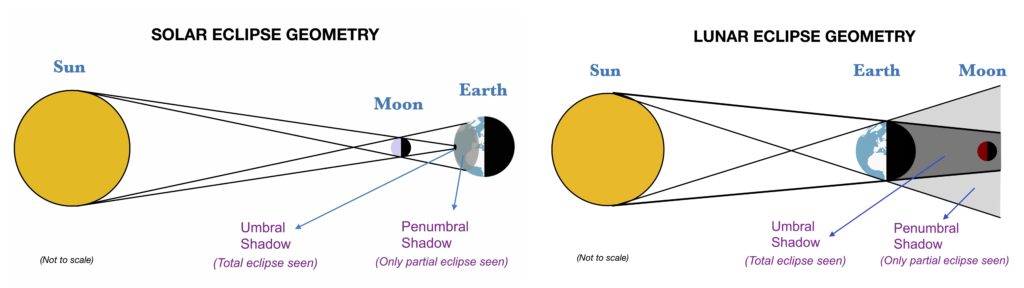
The Earth is about 3.7 times as large as the Moon, and hence its shadow is much larger than the Moon as well. Hence, during a solar eclipse, the size of the umbral shadow of the Moon on the Earth is about 100-150 km wide. All locations over which this umbral shadow passes, will see a total solar eclipse at that time. All locations under the Moon’s penumbral shadow will see a partial solar eclipse.
However, the Moon is much smaller than the umbral shadow of the Earth and hence all of the Moon can experience a total lunar eclipse. If the Moon does not pass entirely within the umbra, then we can see a partial lunar eclipse instead.
Check out this page or this page for information on upcoming eclipses!