
A partial solar eclipse will be seen from the North Western part of Africa on 12 August 2026, while the totality ends just north of Algiers in the Mediterranean Sea after passing through Spain. While the eclipse is as much as 85-95 % for the northern most parts of Algeria and Morocco, it is more than 30% in Tunisia, Mauritania, Mali, Senegal, Guinea, Gambia, Guinea-Bissau, Sierra Leone, and Cape Verde and is less than that in Cote D’Ivoire, Liberia, Ghana, Burkina Faso, Niger, Mali, and Libya.
This is a sunset eclipse, and most places mentioned above will not be able to see the end of the eclipse due to the sunset occurring before the end of the eclipse. Note that no part of Africa will see the total solar eclipse, but only varying degrees of partial eclipse depending on their location.
A page on the eclipse from Algeria (in Arabic, French, English)
Livestreams:
- Tunis Science Centre, Tunisia
- European Space Agency
- NASA
- Exploratorium
- Timeanddate.com
- Royal Observatory Greenwich
- SIU, SolarStream, Spain
- Slooh
Public events
- Tunis Science Centre, Tunisia (6:30 PM to midnight, eclipse glasses available, poster)
- CDEPS Guediawaye, Senegal (6:00 – 7:15 PM, eclipse glasses available, map)
- Atlas Golf Marrakech & Oukaimeden Observatory, Morocco (6:30 – 8:38 PM, eclipse glasses available, Poster)
Timings and locations
Click here for an interactive map to find out the timings of the solar eclipse for any location.
We have created a table here with timings for some important cities in the countries that can see this eclipse.
If you are organising a public event to see the eclipse from Africa, let us know through this form, so that we can publicise it.
If you are organising a livestream of the eclipse from Africa, let us know through this form, so that we can publicise it.
If your organisation has made an info poster or a video about the eclipse, you can share it with us by uploading it here.
If you post about the eclipse on social media, do tag us!
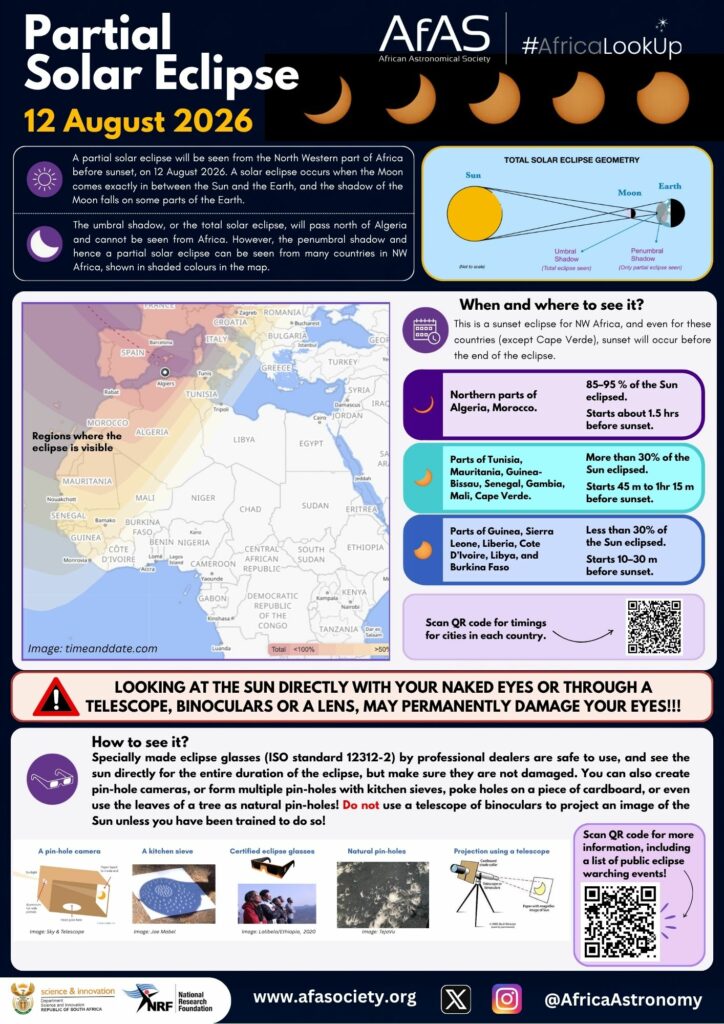
Click on the image to download a hi-res PDF.
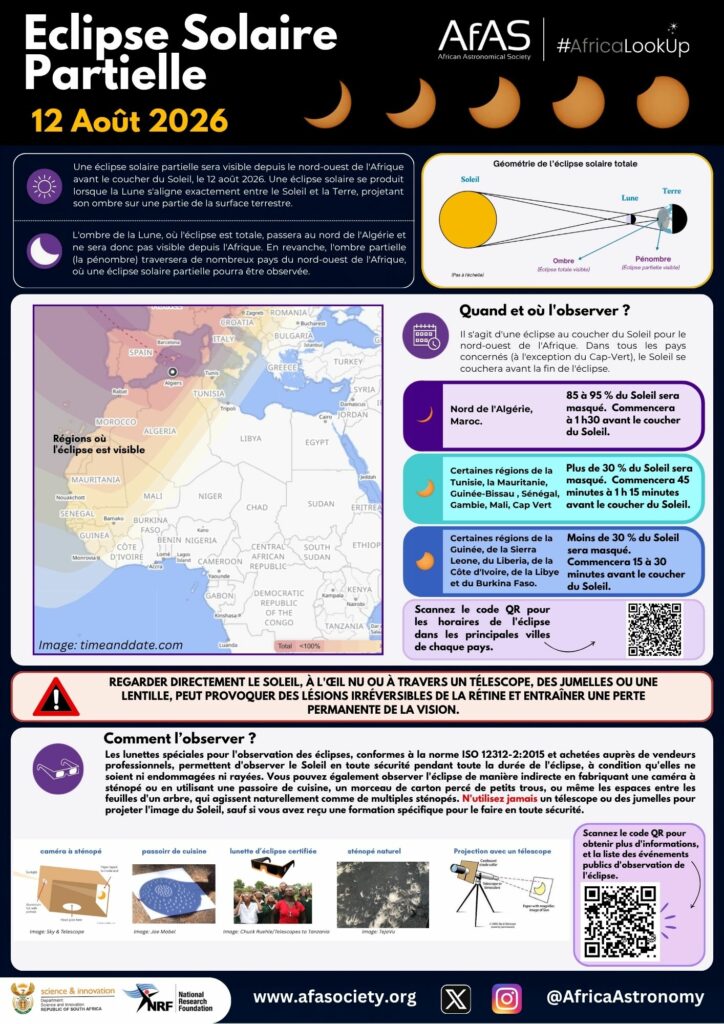
Cliquez sur l’image pour télécharger un PDF haute résolution.
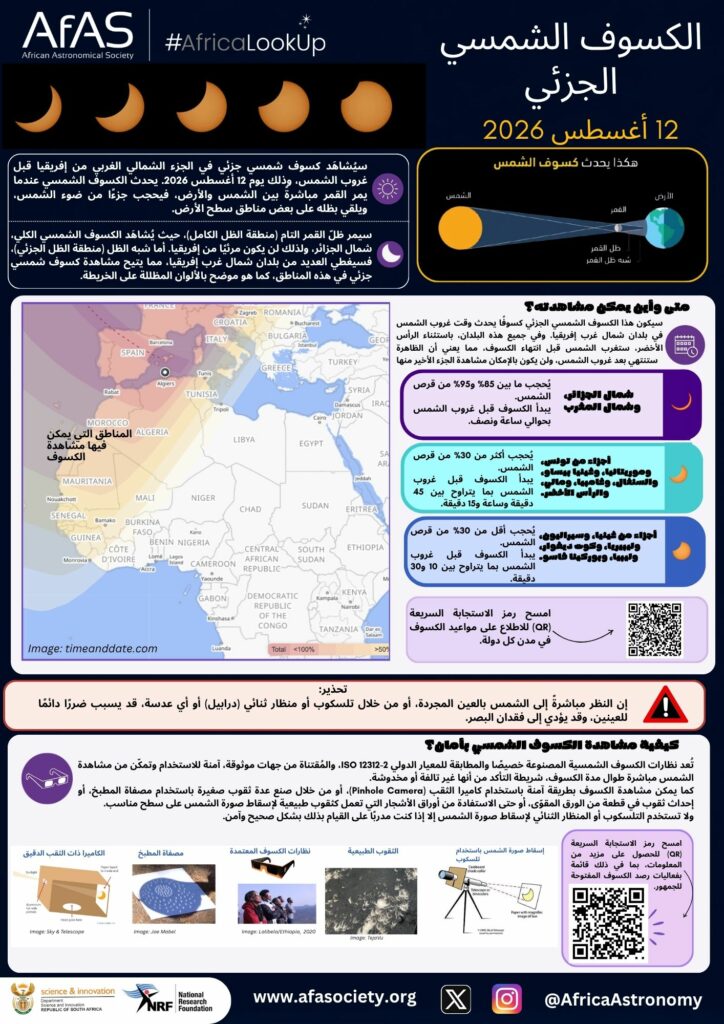
انقر على الصورة لتنزيل نسخة PDF عالية الدقة
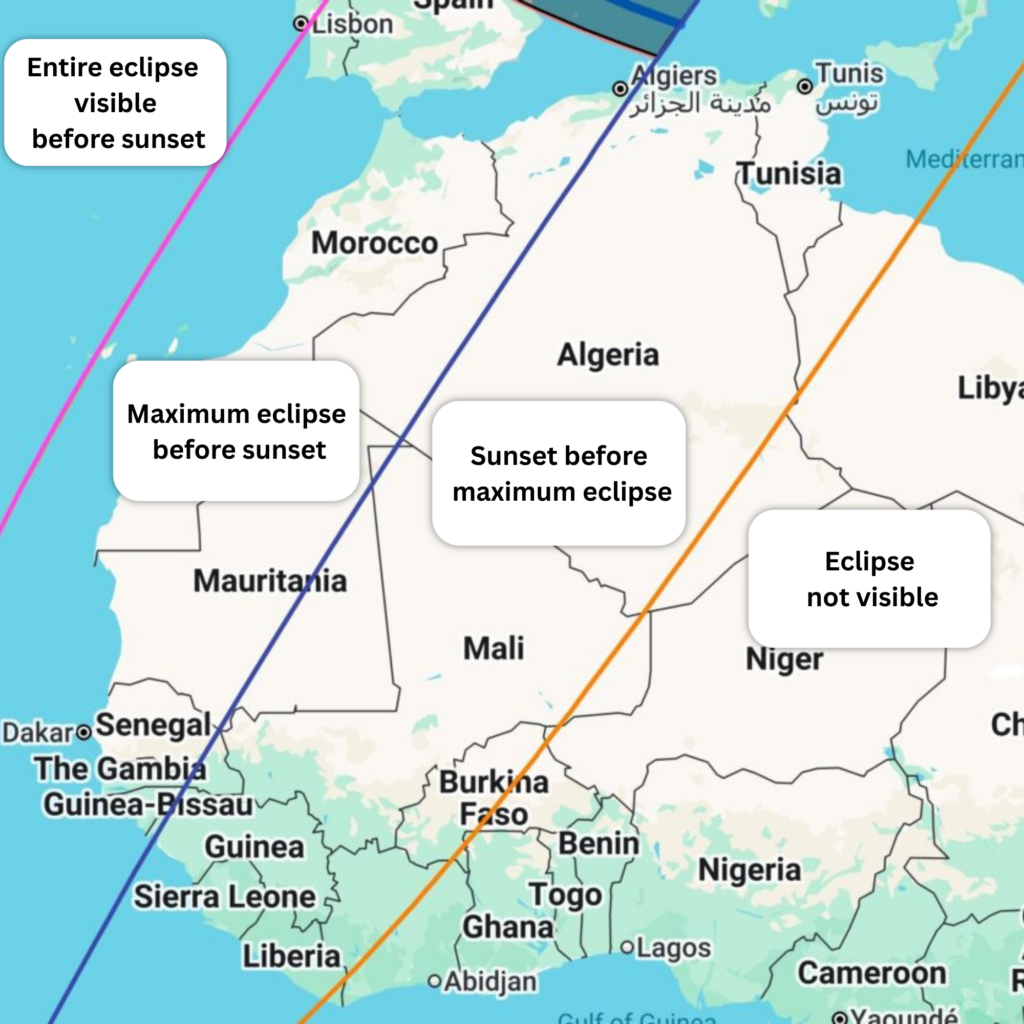
In the figure above, taken from here, all locations left of the pink link will see the entire eclipse before sunset, and no part of Africa is in this location.
All locations between the pink line and the blue line will see the maximum eclipse before sunset.
All locations on the blue line will see their maximum eclipse exactly at sunset.
All locations between the blue and the brown line will have sunset before the maximum eclipse occurs.
All locations right of the brown line will not be able to see any part of the eclipse.
Safe ways to enjoy the solar eclipse
It is dangerous to look at the Sun using a telescope or a pair of binoculars, or even directly with your unaided eyes – even during an eclipse. You will damage your eyes! Do not use x-ray films or sunglasses either, these do not block the sunlight sufficiently.
So how can we enjoy the glorious spectacle that is a solar eclipse? There are many ways to do so while being safe!

Pin-hole camera
Pin-hole cameras are simple to construct, and can be used to see the progression of the solar eclipse easily.
Of course, the length of the pin-hole tube needs to be quite long to get a reasonable size of the solar image. Can you make a pin-hole camera for this eclipse?
Natural pin-holes
There are many ways of using existing pin-holes and a long enough path length, to get a bigger image of the Sun. The space between leaves of a tall tree are excellent pin-holes, and we can see tens of eclipsed sun images under a tree dancing in the breeze! Collanders and sieves, or a cardboard with holes cut in it held at a height above the ground can also be used.
Eclipse glasses
The safest and easiest way to enjoy a solar eclipse is through special eclipse glasses. Make sure these are ISO standard 12312-2 and are made by professional dealers. Ask your local planetarium, amateur astronomy club, or science centres if they have some for you!
Telescope projection
There are safe ways to project the image of the Sun through a telescope and see that image. However, you would need to be trained to do so safely, without damaging your eyes or your telescope. Hence, DO NOT try this if you have not been trained to do so! Contact your nearest amateur astronomy club instead.