Background of the project
The Cascade Outreach project is an astronomy engagement initiative designed to expand access to science education and inspire young people to consider careers in science. The model was developed by the Inter-University Institute for Data Intensive Astronomy (IDIA) and has been implemented through outreach programs linked to National Science Week in South Africa.
At the core of the Cascade Outreach model is the idea that science engagement should be relatable and community driven. Instead of relying only on senior scientists, the program trains postgraduate astronomy students and early career researchers to act as outreach ambassadors. These ambassadors visit schools and communities, sharing their research, personal experiences, and career journeys with learners.
This approach creates a cascading effect of learning and inspiration. By interacting with young scientists who come from diverse backgrounds, learners are more able to see themselves represented in scientific fields. During the National Science Week implementation, outreach teams visited schools across several provinces in South Africa, reaching thousands of learners and hundreds of teachers through presentations and interactive astronomy activities.
In addition to benefiting learners, the initiative also helps participating students develop important science communication and public engagement skills, contributing to a growing network of scientists committed to making astronomy more accessible to society.
National Science Week (NSW) 2023
The NSW 2023, an initiative with a strong focus on astronomy and science outreach activities. This effort was part of the larger objective set by the Department of Science and Innovation (DSI) to promote STEMI (Science, Technology, Engineering, Mathematics, and Innovation) across South Africa.
The National Science Week (NSW) 2023 Outreach Program was organized by the African Astronomical Society (AfAS) in collaboration with the IAU-GA 2024 Outreach and Education Committee. The initiative was guided by the central theme “Transforming lives through evidence-based science,” while also aiming to promote astronomy, highlight its career opportunities, and encourage interest in sustainable energy research. In doing so, the program sought to contribute to building a scientifically literate society by demonstrating the value of STEMI fields. Activities were designed to engage a wide and diverse audience, including learners, educators, members of the general public, as well as students, researchers, and scientists.
Summary of Implementation by Province
| Province / District | Team Leaders / Organizers | Number of Activities |
|---|---|---|
| Gauteng (City of Johannesburg) | Duduzile Kubheka & Dr. Tshiamiso Makwela (Johannesburg Group Head) | 14 face-to-face outreach activities were hosted, including presentations, quiz games, and motivational talks. |
| Free State (Fezile Dabi District) | Nadine Sims & Lusanda Tamesi | 5 days of face-to-face ONSITE activities and 5 days of face-to-face OUTREACH activities were hosted, including presentations and quizzes. |
| Western Cape (City of Cape Town) | Duduzile Kubheka (overall organizer) | Planned for school talks, presentations, and exhibitions (2 events per day for 5 days) and public sky viewing/engagements (4 evenings). |
| KwaZulu Natal (uThukela District Municipality) | Duduzile Kubheka (overall organizer) | Planned for school talks, presentations, and exhibitions (2 events per day for 5 days) and public mall outreach (2 evenings). |
Cascade seed grants 2024
The Cascade Seed Grants Project brought the wonders of astronomy closer to communities across Africa, making science more accessible, inclusive, and inspiring especially for young people. By combining hands-on activities, storytelling, and engagement with local role models, the initiative showed that science is for everyone, regardless of background or resources.
Across schools, science centers, and community spaces, learners were given opportunities to explore the universe, ask questions, and discover how astronomy connects to everyday life. The project also highlighted pathways into STEM, encouraging participants to imagine themselves as part of the future of science.
Profiles of the 2024 Cascade Seed Grant recipients and ambassadors can be viewed [here]
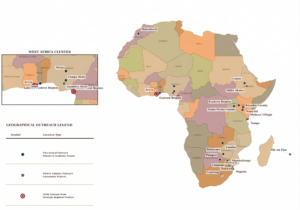
Outreach Activities by Country
| Country | Areas of Activities | Key Activities |
| Tanzania | Muheza, Tanga | Lectures, stargazing, telescope observations, model-making, light pollution discussions |
| South Africa | Acornhoek, Sabie, White River, Vuwani, Johannesburg, Ennerdale, Pretoria | School outreach, STEM talks, women in STEM, demonstrations, stargazing |
| Botswana | Palapye, Tlokweng | School outreach, teacher training, storytelling, experiments, telescope use |
| Zambia | Lusaka | Presentations, parallax activities, STEM career discussions |
| Kenya | Kachibora (Kitale), Kiambu County, Nanyuki | Demonstrations, solar system modelling, stargazing, lectures, teacher training |
| Togo | Lomé, Kpalimé | Talks, telescope assembly, solar observation |
| Nigeria | Nsukka (Enugu), Anambra State, Abuja | Lectures, hands-on builds, robotics, coding, VR experiences |
| Ghana | Chinto (Eastern Region), Accra, Lolonya | Storytelling, skywatch events, workshops |
| Cameroon | South West Region, Buea | Talks, STEM awareness, career discussions |
| Mozambique | Magoanine, Boane District | Stargazing, telescope workshops, rocket demos, girls in STEM |
| Ethiopia | Addis Ababa, Gojam | Lectures, experiments, telescope use, astronomy clubs |
| Uganda | Eastern Region (Iganga, Soroti, etc.) | Telescope assembly, experiments, career guidance, clubs |
| Zimbabwe | Bulawayo | Presentations, quizzes, solar observation |
| Morocco | Marrakech, Agafay | Stargazing, workshops, astronomy clubs |
| Mauritius | Flic en Flac, Telfair | Skywatch events, telescope viewing, discussions |
Public outreach events brought communities together through guided stargazing, telescope observations, and discussions, highlighting connections between astronomy, wellbeing, and astro-tourism.
Overall map of reach through projects